
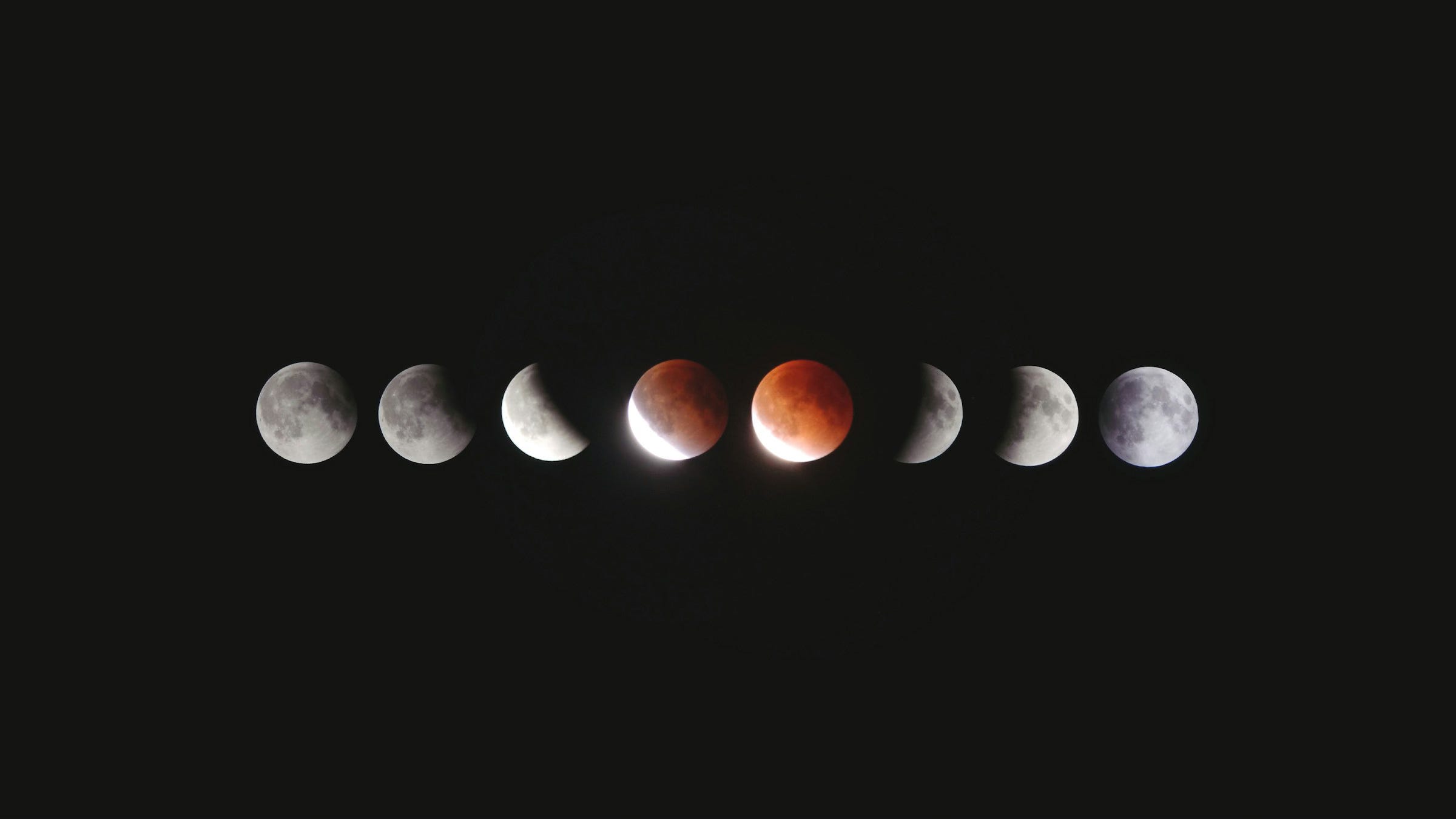
I was nine years old, lying on the rooftop terrace of our home, watching a lunar eclipse with my father. The Moon was turning a deep, burnt orange — a Blood Moon, he called it. I remember staring at that dark curved shadow creeping across the Moon’s face and asking him the question that would stick with me for decades:
“Papa, whose shadow is that on the Moon?”
He smiled and said it was Earth’s shadow. I nodded. But a second question immediately followed, with the unfiltered logic that only a nine-year-old can muster:
“Then... can MY shadow reach the Moon too?”
He laughed. I laughed. We moved on. But the question never really left me.
Fast Forward: The Question Gets Serious
A few weeks ago, I found myself in a long conversation with an AI — starting casually with moon phases, drifting into eclipse geometry, and eventually landing on a thought experiment that I couldn’t let go of:
What if a cosmic giant stood on Earth during a partial lunar eclipse? Where would they need to stand so that the entire world could see their shadow on the Moon?
What started as a playful hypothetical turned into a surprisingly rigorous physics problem — one that pulled in geometry, spherical trigonometry, orbital mechanics, and a world map. Let me take you through it.
First, the Physics of a Lunar Eclipse
During a lunar eclipse, the Sun, Earth, and Moon are nearly perfectly aligned — in that order. Earth casts two shadow cones into space:
The Umbra — the dark inner cone, where sunlight is completely blocked. This is Earth’s full shadow.
The Penumbra — the lighter outer cone, where only part of the Sun is blocked. This causes subtle dimming.
A partial lunar eclipse happens when the Moon clips only partially into the umbra — the alignment is close, but not perfect. The Moon is always in its Full Moon phase during any lunar eclipse, because that’s the only geometry where Earth sits between the Sun and Moon.
Crucially: the dark portion you see on the Moon during an eclipse is NOT the Moon’s own shadow. It is Earth’s shadow, projected onto the Moon’s surface. That’s the key insight my nine-year-old self had stumbled onto.
So... Could a Giant Cast Their OWN Shadow on the Moon?
Here’s where the thought experiment gets interesting. If you’re a cosmic giant standing on Earth, sunlight hits you from the Sun’s direction. Your shadow extends away from the Sun. If the Moon happens to be in the direction your shadow points — you could, in theory, cast your silhouette all the way to the lunar surface.
The geometry requires two things to be true simultaneously:
1. The Sun must be behind you — so sunlight hits your back and your shadow projects forward.
2. The Moon must be in front of you — so your shadow’s path intersects the Moon.
During a lunar eclipse, the Sun and Moon are on nearly opposite sides of Earth. This means your shadow — if cast at a shallow enough angle — could escape Earth and travel 384,000 km to reach the Moon.
The key word is ‘shallow.’ If the Sun is directly overhead, your shadow falls straight down at your feet — it never escapes Earth. But if you’re standing at the terminator — the day/night boundary — the Sun is near the horizon, and your shadow shoots out nearly horizontally into space.
The Maths: Where Exactly Must the Giant Stand?
Let’s put some numbers to this. I worked through it with AI step by step.
At midnight in San Jose, California (my observer’s location), the Sun is directly beneath Earth — on the opposite side of the planet. The terminator line (the day/night boundary) runs along approximately 60°E longitude.
The valid standing zone — where your shadow angle is shallow enough to escape Earth toward the Moon — is a narrow band straddling this terminator. The width of this band depends on your height:
For a giant of height h on Earth of radius R = 6,371 km, the shadow escapes when the Sun’s elevation angle α satisfies:
sin(α) = h / R
For a giant around 1,000 km tall, this works out to a band roughly 1,000 km wide and 40,000 km long (the full circumference of Earth) — straddling the terminator from pole to pole.
That’s about 40 million km² of valid standing area — roughly the combined size of Russia and Canada.
Which Cities Fall in This Zone?
At midnight San Jose time (08:00 UTC), the terminator runs through the Middle East and Central Asia. The valid band spans roughly 50°E to 70°E longitude. The cities inside it: Muscat ★ (sweet spot), Dubai, Abu Dhabi, Tehran, Riyadh, Karachi, and Kabul.
Muscat, Oman, sitting at 58.6°E — virtually dead on the terminator line — is the sweet spot. A giant standing just outside Muscat, facing westward toward the setting Sun, would cast the crispest shadow directly toward the Moon.
And Here’s the Punchline: The Burj Khalifa
Now for the twist that brings this all home.
The Burj Khalifa in Dubai stands 828 metres tall — the tallest building in the world. Dubai sits at 55.3°E longitude, comfortably inside our valid band. Sunlight hits it. Its shadow points eastward — toward the Moon.
So the question becomes: is the Burj Khalifa tall enough for its shadow to escape Earth and reach the Moon?
Let’s check the maths. For a shadow to escape Earth’s surface, the object needs to be tall enough that its shadow tip clears Earth’s curved horizon. The required height h for a given Sun elevation angle α is:
h = R × sin(α)
At the terminator, α approaches 0°, so theoretically even a modest height can cast a shadow that escapes. But the shadow also needs to be tall enough to be optically visible on the Moon’s surface from Earth — a constraint that demands the shadow be at least tens of kilometres wide, which requires an object hundreds of kilometres tall.
The Burj Khalifa at 828 metres would cast a shadow that does escape Earth geometrically — but at 384,000 km away, it would subtend an angle of just 0.00000012° — completely invisible to the naked eye, and even to most telescopes.
But here’s the beautiful part — the physics is correct. The geometry works. If the Burj Khalifa were scaled up to, say, 500 km tall — keeping everything else the same — its shadow would race across 384,000 km of space and paint a building-shaped silhouette on the face of the Moon, visible to everyone on Earth’s night side simultaneously.
The Burj Khalifa already points its shadow at the Moon during a lunar eclipse. It’s just not tall enough for us to notice.
What This Conversation Taught Me About AI
I’ve been in the tech industry for years. I’ve used AI tools for code, writing, and analysis. But this conversation was different. It wasn’t about getting an answer — it was about thinking out loud with a system that could hold the entire problem in context, run the geometry, draw the diagrams, and then ask the next interesting question right alongside me.
We built five diagrams together during this conversation — moon phase charts, orbital geometry, eclipse shadow cones, a world map with the terminator band, all of it. Each diagram came out of a specific moment where I said ‘show me this’ and the AI translated physics into something I could see and feel.
The nine-year-old on that rooftop would have loved this.
The Big Takeaway
Science communicates through stories. The best physics always starts with a question a child would ask — and ends somewhere nobody expected to arrive.
Next time you watch a lunar eclipse, remember: the dark bite on the Moon is Earth’s shadow. Every tall building on the terminator line is already pointing its shadow at the Moon. And Muscat, Oman is, for one night every year or two, the most cosmically interesting city on the planet.
We are all, in a sense, cosmic giants. We just need to stand in the right place.
#Physics #Astronomy #LunarEclipse #AI #Curiosity #STEM #SpaceScience #BurjKhalifa #ThoughtExperiment
If this made you look at the Moon differently — drop a comment below. And if you’ve ever asked a physics question that led somewhere unexpected, I’d love to hear it.